Dinamika Sosial dan Ekonomi Pekerja Informal di TPAS Makassar
Book Review
Reviewer: Dr. Suherman, M.M.
Book Identity
Public Relations IAIN Parepare --- The development of the city marked by increasing urbanization not only gives rise to modernity but also presents the reality of increasingly complex social inequalities. In the urban social landscape, the informal sector grows as an alternative space for groups of people who are not fully accommodated in the formal economic system.
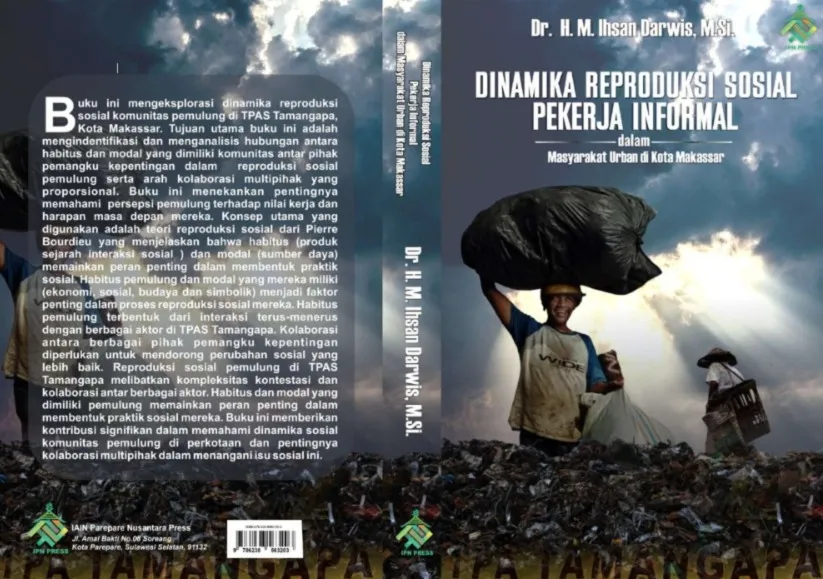
One of the communities living in this dynamic is the scavengers who depend on economic activities in the area of the Final Waste Disposal Site (TPAS). This reality is the focus of the book. Dynamics of Social Reproduction of Informal Workers in Urban Society in Makassar City by Dr. H. M. Ihsan Darwis published by IAIN Parepare Nusantara Press in 2024.
This book starts from the assumption that TPAS not only functions as an economic space for informal sector workers, but also serves as a social arena that brings together various actors with diverse interests. In the context of urban society in Makassar City, the TPAS Tamangapa arena becomes a contested space filled with power relations among scavengers, collectors, stall owners, local government, non-governmental organizations, local political actors, and financial institutions such as NGOs and the Cash Direct Assistance (BLT) program.
Theoretically, this book uses the social practice approach of Pierre Bourdieu as an analytical framework. From Bourdieu's perspective, social practice is the result of the dialectic between habitus, capital, and arena. Habitus refers to the social dispositions formed through the life experiences of individuals or groups within a specific social structure. Capital is understood not only in economic terms but also includes social, cultural, and symbolic capital. Meanwhile, the arena is the social space where the struggle for interests among actors occurs in the competition for resources and legitimacy.
Through the generative formulation (habitus × capital) + arena = practice, the author shows that the activities of scavengers at the Tamangapa landfill are not merely driven by economic needs, but also represent a social strategy to maintain existence amid a competitive social structure. Since 1993, social contestation has occurred between native scavengers and collectors and stall owners through mechanisms of waste distribution and weighing. The geographical proximity between the scavengers' settlements and the stalls has become an economic efficiency strategy that allows them to minimize operational costs.
This dynamic has become increasingly complex since 1998 when migrants from various districts/cities began to crowd the landfill area due to the rising volume of urban waste triggered by the consumption patterns of urban society. The entry of new actors expands the spectrum of social contention in the landfill arena, while also forming a new relational structure involving various political, economic, and social interests.
Local government intervention through the recruitment of scavengers as cleaning staff and garbage truck drivers indicates an effort for social integration as well as structural control over the landfill arena. In this context, the dominance of financial institutions—both from the government and investors—becomes a key factor in determining the level of welfare for scavengers. Economic capital functions as a control center that shapes collective agreements among the actors and directs the social practices of the scavenger community to this day.
From the perspective of the reviewer, the professional background of the author before becoming an academic contributes to the depth of analysis in this book. The author's experience as the Head of the Office of Religious Affairs (KUA) within the Ministry of Religious Affairs of the Republic of Indonesia in the Makassar City area allows for the development of social sensitivity to the realities of marginalized community life. This makes the discussion in the book not only stop at the theoretical level but also reflects practical experience in understanding the social dynamics of lower-class society.
Nevertheless, there are several constructive notes that can strengthen the development of future editions. This book would be even more comprehensive if it included more applicable public policy analysis, particularly related to the empowerment of informal sector workers in urban areas. In addition, exploration of gender dimensions within the scavenger community and the integration of community-based empowerment models could also enrich the practical contributions of this book.
Overall, this book makes a significant contribution to urban sociology studies, particularly in understanding the dynamics of social reproduction of informal sector workers amidst the complexities of urban social structures. The social practices of the scavenger community in the Tamangapa TPAS arena show that the survival strategies of marginalized communities are inseparable from the power relations formed through the distribution of capital within the social structure.
This book is worthy of being a reference for academics, community empowerment practitioners, and policymakers who are concerned with community-based social development in urban areas.
in Research
Recent News